

Concrete Driveway Aprons in Schaumburg, IL
Tear-out and repour of the strip between the street and your driveway, poured to the village's 5-inch apron spec, permitted, and inspected before and after the pour.
Where Your Driveway Apron Starts and Ends
Walk out to the street and look back at the house. The apron is the piece of concrete that runs from the curb, across the grass strip (the parkway), to the public sidewalk. Past the walk, on your side of the property line, it is driveway. That short strip sits on village right-of-way, takes the worst of the street, and has its own spec in the village code, which is why it gets talked about separately.
| Strip | Who has a say | What it means for your job |
|---|---|---|
| Curb and gutter | The agency that maintains the street: the village on most Schaumburg streets, the state or county on the big roads. | We form against the existing curb and leave a clean joint at it. We do not rebuild curbs or gutters, and the apron job does not include them. |
| Apron, across the parkway | Village right-of-way, covered by the same village driveway permit as the rest of the drive. | This is the strip we tear out and repour. The village code calls for at least 5 inches of non-reinforced concrete here. |
| Public walk crossing | Village right-of-way. | The walk panels where the driveway crosses usually come out with the apron, and they go back in at the existing walk's line and height so nobody trips on a lip. |
| Parkway trees | The village wants any parkway tree within 10 feet of the driveway drawn on the permit survey. | Roots near the apron shape the plan. Nobody should cut roots of a parkway tree without talking to the village first. |
| Private driveway | You, under the same village permit if it is being replaced. | Optional. The apron can be done alone or with the driveway behind it. See the tool below. |
Two other uses of the word cause confusion. Some people call the slab just outside the garage door the "apron." That is the top of the driveway, and if it has cracked along with the garage floor, our garage floor repair page covers it. And on commercial sites, a loading apron is a heavy truck slab at a dock, a different job from anything on this page.
Free Driveway Apron Estimates
Tell us what the apron is doing: scaling at the street, cracked at the walk, sunk over a trench, or too narrow for the new garage. We will come out, measure from the curb to the garage, look at the parkway trees and the walk, and tell you whether we would do the apron alone or with the driveway. The estimate comes in writing.
Prefer to talk it through? Call 847-610-6459, Monday to Saturday, 7am to 6pm.
Get a Free Estimate
Tell us about the project and we will get back to you within one business day. Prefer to talk? Call 847-610-6459.
Every detail of the finished driveway looks amazing. The concrete cured beautifully, the surface is smooth, and the overall quality is outstanding.
Why the Driveway Apron Fails First
On a lot of Schaumburg streets the driveway behind the walk still looks decent while the apron is flaking, cracked, or tipped toward the gutter. That is not bad luck. The apron gets a different, harder life than the rest of the slab. Open each one to see what it does and what we look for.
Plow blades and the windrow at the end of the drive
Every street plow pass leaves a ridge of packed snow across the end of the driveway, right on the apron. Then a steel shovel, a snow blower scraper, or a plow service blade set too low goes after it, again and again, all winter. The leading edge at the curb and the surface just behind it take that abuse first. A new apron cannot stop the plow, but crisp, well-finished concrete with enough air in it holds up to the scraping far better than a soft, overworked surface.
Salt spray and street meltwater sitting at the gutter line
The apron sits next to the gutter, which carries salty meltwater from the whole street. Plows throw salted slush onto it, and the low end near the curb stays wet longer than any other part of the drive. Wet concrete that freezes and thaws with salt in it scales: the top skin flakes off and the stone shows. This is the "scaling out at the apron" we see on so many 1960s to 1980s slabs around here.
The joint at the curb and the joint at the walk
An apron has a hard edge on each end: the curb on one side and the public walk on the other. If those joints were never given proper expansion material, or were filled with asphalt that has since crumbled, water runs straight down into the base. The concrete beside the joint cracks, chips, and starts to move on its own.
Settlement over a utility trench
Water, gas, and cable service lines often run under the parkway and the apron. When one of those trenches was dug and backfilled without good compaction, the fill keeps settling for years, and the apron sinks in a line across the drive. We do not do utility work. What we do is dig out the soft fill under our slab, rebuild the base with compacted stone, and get it inspected before we pour, so the new apron is not sitting on the same soft spot.
Thin original pours
Many original aprons in the northwest suburbs went in at 3 or 4 inches. On the original Kimball Hill blocks in Rolling Meadows, the driveways were poured at three. Schaumburg now calls for at least 5 inches of concrete at the apron, so the replacement is thicker than what comes out, and the dig goes deeper to make room for it.
Parkway tree roots
A mature parkway tree a few feet from the drive can lift the apron or the walk panel next to it. The village asks for any parkway tree within 10 feet of the driveway on the permit survey, so the tree is part of the plan from day one. Sometimes the right answer is a slightly different joint layout around the roots rather than cutting anything.
Driveway Apron Replacement Alone, or With the Driveway?
This is the decision most people call about. Here is the part that costs us work: if the driveway behind the walk is sound, replacing only the apron is often the right call, and it is a much smaller check. Answer the questions below and the tool will point to the option we would most likely recommend. All three options are written out underneath, so you can read them either way.
One more option that is not on the list: if the apron is sound and only the joint at the walk or the curb has opened up, a joint repair may be all it needs. We will tell you that on the estimate rather than sell you a new apron.
Widening a Driveway Apron for a Wider Garage
Add a garage bay or a wider drive, and the first question is what happens at the street. Schaumburg's driveway rules answer most of it:
- 21 feet at the street end. A driveway can be no wider than 21 feet within 3 feet of the front property line. Past that point it can widen at an angle of no more than 45 degrees. A three-car garage does not get a three-car-wide apron. The drive necks down before it reaches the walk.
- 9 feet minimum. No driveway, apron included, can be narrower than 9 feet.
- New concrete pinned to old. When concrete is added to an existing driveway, the village calls for number 4 rebar to pin the new pour to the old slab.
- Older wide drives can stay. A driveway wider than 21 feet at the walk that was legal and in place before March 1, 2005 can be repaired or replaced, but the replacement cannot be any wider than what is there now.
That is why apron extensions for a new garage are usually about the flare behind the walk, not a wider strip at the curb. We draw the new outline on your survey so the village sees the 21-foot line and the angle before anything is cut.

One curb cut, and the two-driveway exception
The village allows one curb cut per lot, except for circular drives. A single-family property can have two driveways only when all three of these are true: the lot has more than one street frontage, it has a detached garage, and the two driveways are on different frontages. Anything else needs a zoning variation, which is a separate approval from the driveway permit. Variations do get granted. In 2021 the village passed an ordinance allowing two curb cuts at 33 Aspen Drive under section 151.108(G)(1) of the zoning ordinance. But nobody should promise you one, and we will not pour a second apron on the hope of it.
The Schaumburg Village Permit and Inspections for an Apron
The Village of Schaumburg requires a permit to add a new driveway or replace an existing one, and the apron is part of that permit. There is no separate apron permit to chase.
- The fee. $105 for new or replacement work. $50 for a repair of less than 50%. If the job also replaces a stoop or a private walk, the village's sidewalk and stoop permit is $65.
- The contractor's license. If you hire the work out, the contractor has to hold a Village of Schaumburg Contractor's Business License before the village will issue the permit. Ask every bidder whether theirs is current.
- The drawing. A Residential Building Permit application plus a current plat of survey, as a PDF scanned at high resolution. Photos of the survey get rejected. The survey has to show every existing structure, accessory structure, and hardscape, with the new apron and driveway drawn and dimensioned right on it, and any parkway tree within 10 feet of the drive.
- The spec the inspector holds us to. The apron: at least 5 inches of non-reinforced concrete, with the village calling for a 6 bag mix. The driveway behind it: 4 inches of concrete over 4 inches of compacted stone base. Flatwork pitched away from the house.
- Two inspections. A sub-base (rough) inspection after the base is in and before any concrete arrives, and a final inspection after. Inspections are scheduled through the Permitting Division of Community Development at 847-923-4420, by 4pm the business day before.
We draw the survey, submit it, schedule both inspections, and do not pour until the sub-base passes. Outside Schaumburg, each village runs its own process, and we check with that village before we schedule.
Unincorporated Lots, State Routes, and County Roads
Most aprons in Schaumburg meet a village street, and the village permit covers them. Two situations bring in someone else.
Unincorporated Schaumburg Township
If your home has a Schaumburg mailing address but sits in unincorporated Cook County, the village is not your permit office. Schaumburg Township's Road and Bridge department requires a permit for driveways, and Cook County will deny a construction application if that township filing has not been made. Cook County's flatwork permit requirements also call for a permit waiver from the Township Highway Commissioner, and work that runs past your lot line into the right-of-way needs separate approval from the township highway department. Check your tax bill or call the village if you are not sure which side of the line you are on.
Aprons onto state and county roads
The village lists the roads in Schaumburg it does not maintain. The Illinois Department of Transportation has Barrington Road, Irving Park Road, Higgins Road (Route 72), Golf Road, Algonquin Road, Meacham Road from Algonquin Road north, and Rohlwing Road from Biesterfield Road south. Under Illinois rules, rebuilding an existing driveway within the right-of-way of a state highway needs a state permit, generally issued by the IDOT district office. Cook County maintains Schaumburg Road, Roselle Road, Central Road west of Roselle, Wise Road west of Roselle, Meacham Road from Higgins Road south, and Plum Grove Road from Higgins Road south.
If your apron meets one of those roads, the road's owner gets a say before the street end is touched. We sort out who that is before we price the job, because the answer can change the schedule.
Every job: the locate
Illinois law requires anyone digging to notify JULIE (call 811) at least 2 days and no more than 10 days before the dig starts, so the utilities can mark their lines. With service lines running under so many parkways, we never skip it.
How a Driveway Apron Job Goes
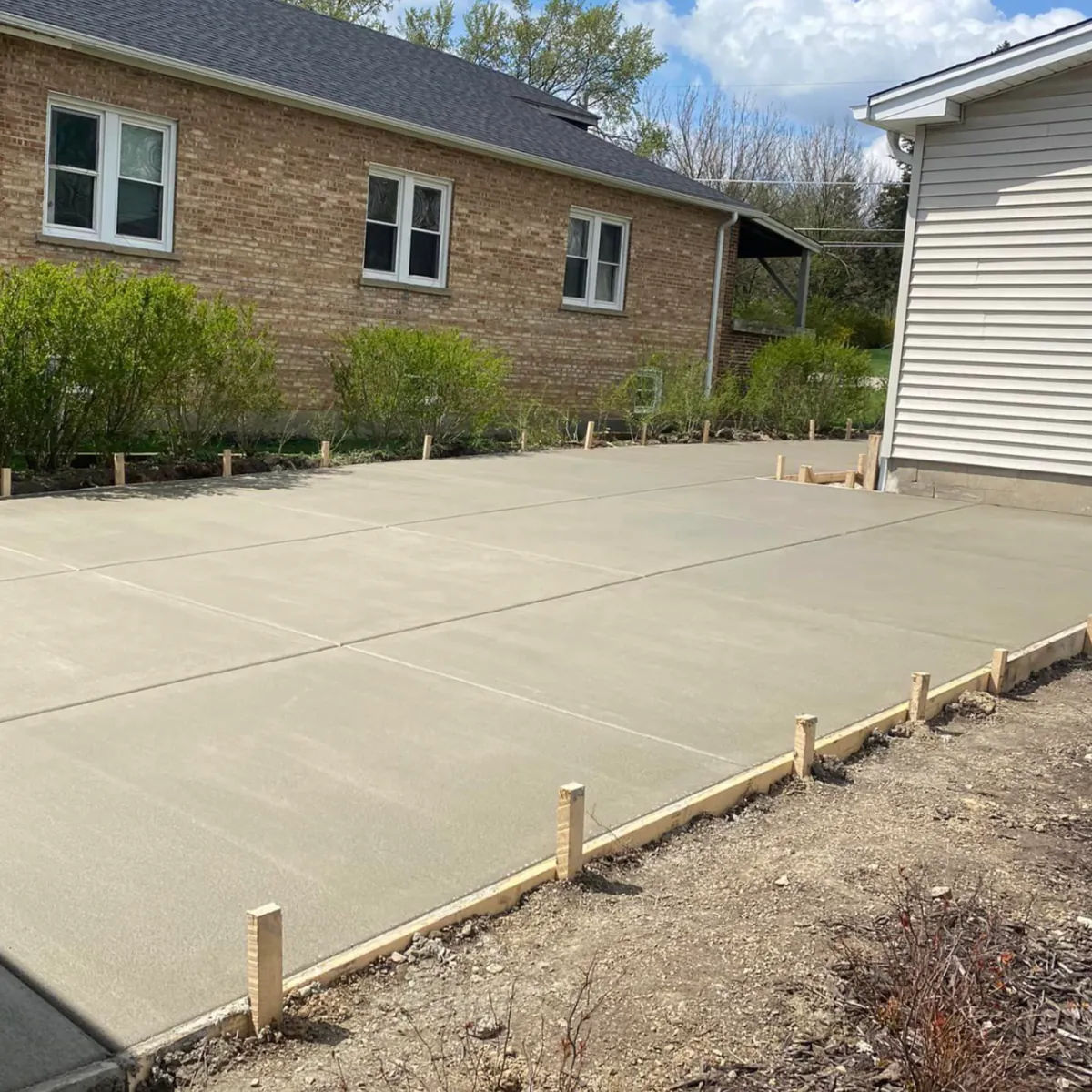
-
Permit, survey, and locates
The survey drawing goes to the village, and JULIE marks the utilities. Nothing is cut until the permit is issued.
-
Saw-cut the edges
A full-depth saw cut along the driveway side, at the walk or the nearest joint, so the old concrete breaks out on a straight line and the slab you are keeping is not cracked by the demo.
-
Break out and haul
The old apron and the walk panels it crosses come out, along with soft fill over any trench and any old asphalt patching at the curb.
-
Base, then the sub-base inspection
Compacted stone, deep enough for the 5-inch apron. The village inspects it, and the pour waits until it passes.
-
Form, pour, and finish
Forms go in, expansion material goes against the curb and the walk, and the apron is poured with an air-entrained mix, broom finished, jointed, and pitched to carry water to the gutter.
-
Cure and the final inspection
Curing compound goes on the same day. Forms come off, the parkway edges get backfilled, and the village does its final.
Where the cars go while it cures
Foot traffic is fine after 24 hours. Passenger cars wait 7 days, and anything heavy, like a moving truck or a loaded trailer, waits 28. On an apron job, that means your cars are out of the garage for a week. Schaumburg bans parking on village streets from 2:30am to 6am. You can ask the police department for permission by dialing 311 or calling (847) 882-3586, but the village caps it at five requests in 30 days, and after two inches of snow overnight parking can be suspended. A week of curing is longer than five nights, so line up a neighbor's driveway or another off-street spot before pour day.
The first winter
The concrete industry's advice is to keep deicers off new concrete for its first year, and never to use ammonium nitrate or ammonium sulfate products, which attack the surface. On your own apron, use sand for traction that first winter. Ask your plow service to raise the blade a little at the street end, and clear the windrow with a plastic shovel if you can. The salt the street plows throw is out of your hands, which is one more reason to pour aprons in spring and summer.
Concrete Aprons on Asphalt Driveways
Plenty of Schaumburg homes have an asphalt driveway with a concrete apron, or an asphalt drive that runs all the way to the curb. The village's code list gives one spec for the apron, and it is concrete: at least 5 inches, non-reinforced. Asphalt driveways get their own spec of 3 inches of asphalt over 6 inches of stone. So keeping the asphalt drive and putting a concrete apron at the street is a normal combination here.
The transition is where these jobs go right or wrong. We saw-cut a straight, square line where the apron will meet the asphalt, pour the apron against it, and set the concrete edge so it sits flush with the asphalt, not a lip above it that catches the plow. One honest limit: we do not pave asphalt. If the asphalt behind the new apron needs patching or a new top coat, that is an asphalt contractor's job, and we leave them a clean edge to work to.
What Drives the Price of a Driveway Apron
We do not publish a flat apron price, because aprons vary more than people expect: a single-car apron with no flare on a short parkway is a different job from a flared 21-foot apron with three walk panels and a tree beside it. For context, a straightforward broom finish driveway replacement in Schaumburg and the nearby suburbs runs about $9 to $15 per square foot in 2026. An apron on its own is a small pour, and small pours cost more per foot than a full driveway because the saw, the demo crew, the truck, and the inspections cost about the same either way.
- Size and shape. Width, the depth from curb to walk, and how much flare.
- Walk panels. How many public walk panels the driveway crosses and come out with it.
- Thickness. Going from an old 3- or 4-inch apron to the village's 5-inch minimum means more digging and more concrete.
- What is underneath. Soft trench fill or a wet clay base has to come out and be rebuilt before the sub-base inspection.
- Roots and access. A parkway tree, a tight street, or no room for the truck adds time.
- Finish. Broom is the standard. Exposed aggregate adds roughly $2 to $3 per square foot over broom, and we confirm what the village will accept in the right-of-way first.
- Apron alone or with the drive. Doing both at once spreads the fixed costs over more square feet.
- The permit. $105 for replacement, $50 for a repair under 50%.
Our 2026 driveway cost guide breaks down the rest of a driveway price. For your apron, we measure, look at the base and the trees, and put the scope and the price in writing.
What to Ask Before You Sign for Apron Work
- Who pulls the permit? The answer should be the contractor, and their village business license should already be on file.
- How thick is the new apron? At least 5 inches in Schaumburg. If the bid does not say, ask.
- Is the mix air-entrained? The apron gets more salt and more freeze-thaw than any other concrete on your lot.
- Where is the cut line? At the walk, at a joint, or somewhere in the driveway, and what happens to the walk panels.
- What goes against the curb and the walk? Expansion material, not asphalt and not nothing.
- What if they find a soft trench? How the base gets rebuilt, and whether that is in the price or an extra.
- When can I drive on it, and where do I park? A good contractor has thought about the overnight parking ban before you have.
- Who calls JULIE? The contractor, before the saw comes out.
Driveway Apron FAQ
In Schaumburg, apron work goes under the same village driveway permit as the rest of the drive, pulled by you or your contractor, and the village sets the apron spec. The village's driveway guide does not say it will replace a worn apron for you. The village does repair parkway grass damaged by its own snow equipment, so if a village plow or a village dig damaged your apron, dial 311 and ask before you hire anyone.
Sometimes. The village has a repair category for work under 50% of the driveway, with a $50 permit. But a thin patch at the curb line rarely survives the next plow season. We usually cut back to the nearest joint and replace whole panels, so the new concrete is full depth and has a clean edge on every side.
Foot traffic after 24 hours, passenger cars after 7 days, and moving trucks or anything heavy after 28. Plan where the cars will sleep that week, because Schaumburg bans parking on village streets from 2:30am to 6am and caps overnight permission at five requests in 30 days.
Only if the apron is the problem. We can pitch a new apron to carry water to the gutter and set it at the right height against the walk. We cannot change the grade of the street or the gutter, so if the gutter itself holds water in front of your house, a new apron will not fix that, and we will tell you so before you pay for one.
Ask first. The apron sits in the village right-of-way, and the village code sets its thickness and mix. Broom is the standard. If you want exposed aggregate at the street end to match a new drive, we confirm what the village will accept before we plan it. Inside your lot line, the finish is your choice.
Related Driveway Work and Nearby Towns
Other concrete work we do
- Concrete Driveways: new pours, full tear-outs, and widenings from the garage to the walk.
- Sidewalks & Walkways: front walks and village sidewalk panels, including the walk that meets the drive.
- Exposed Aggregate Concrete: a stone surface for driveways and walks, with the street end checked against village rules.
- Garage Floor Repair: the slab inside the door, often replaced with the top of the drive.
- Driveway cost guide: what goes into a 2026 driveway price in Schaumburg.
Apron work in nearby suburbs
- Hoffman Estates: apron work on Route 72 corridor streets, where aprons always need a village sign-off.
- Carol Stream: 40 to 55 year old driveway slabs finally scaling out at the apron.
- Rolling Meadows: original Kimball Hill driveways poured at three inches and now crumbling at the apron.
Apron Crumbling at the Street?
Free on-site estimate within 48 hours. We will look at the apron, the walk, the parkway, and the driveway behind it, tell you plainly whether the apron alone will do, and leave you with a written quote.
847-610-6459