
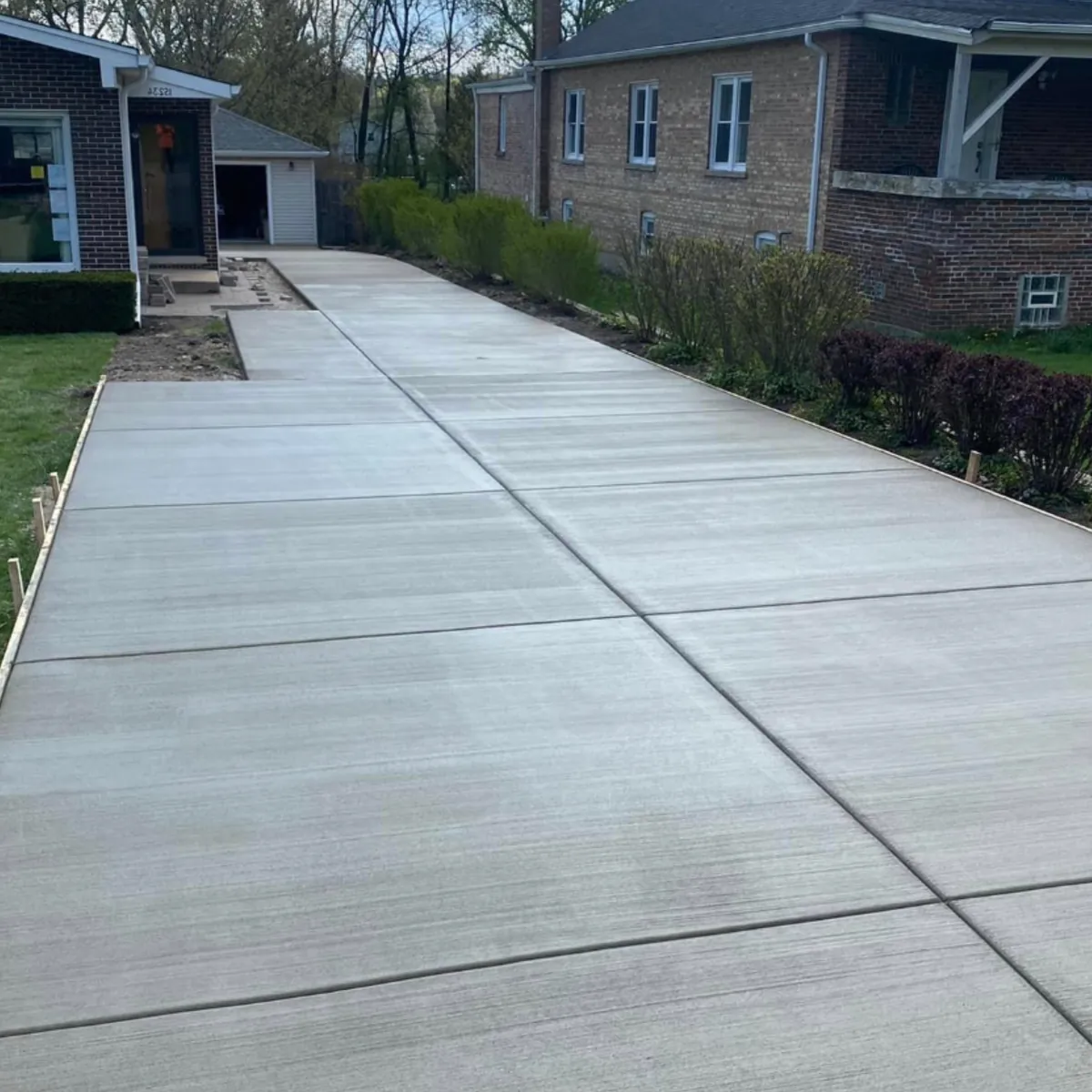
Exposed Aggregate Concrete in Schaumburg, IL
New driveways, patios, front walks, and pool surrounds poured with the stone showing at the surface. Grippy when it is wet, forgiving of dirt, and built for a Schaumburg winter.
What Exposed Aggregate Concrete Is, Up Close
Kneel down on a broom finished driveway and all you see is cement paste: sand and cement, combed into ridges. The stone that gives concrete its strength is down there, but it is buried under that skin. Exposed aggregate concrete is the same slab with the skin taken off the top, so the tops of the stones become the walking surface.
The trick is how much comes off. The working rule in the trade is to remove paste to no more than about a third of the stone's diameter. The top of each stone shows, and the rest of it stays locked in the slab. Take off too little and the surface looks muddy and patchy. Take off too much and the stones have nothing holding them, and they start coming loose the first winter.
Everything else on this page follows from that cross-section: which stone you pick, how the paste gets removed, why it grips better than broom, and why it is harder to patch.
Free Estimates on Exposed Aggregate Concrete
Tell us what you are pouring and where: a driveway, a back patio, a front walk, or the slab around a pool. We will come out, measure, talk through stone choices and whether exposed aggregate is even the right finish for that spot, and put the estimate in writing.
Prefer to talk it through? Call 847-610-6459, Monday to Saturday, 7am to 6pm.
Get a Free Estimate
Tell us about the project and we will get back to you within one business day. Prefer to talk? Call 847-610-6459.
This is a great company that truly cares about their customers. We have collaborated on a few projects and everytime we have been impressed by the attention to detail and worksmanship. This company is a great resource for Schaumburg homeowners to consider when they are in the market for new concrete.
How Aggregate Concrete Gets Exposed
Every exposed aggregate pour starts the same way as any other: compacted base, forms, reinforcement, an air-entrained mix, screeded and floated flat. The difference is what happens to the surface after that, and there are two ways to get there.
Surface retarder, washed the next day
Right after finishing, a chemical surface retarder is sprayed over the slab. It slows the set of only the top skin of paste while the concrete below hardens normally. The slab gets covered, and the next day the softened paste is scrubbed and rinsed off to the depth the retarder allowed. This is how most exposed aggregate gets done now, because it takes the guesswork out of the timing and gives the crew a wide window. Retarders come in different strengths for a light, medium, or deep exposure, so the depth is chosen before the pour, not discovered during the wash.
Timed wash and brush
The older way uses no retarder at all. Once the slab has set enough, the crew sprays water and works the surface with a stiff broom until the stone shows. It works, but the window is short. Start too early and stones pull out with the paste. Start too late and the paste will not come off evenly. On a big driveway, the far end of the slab is ready at a different time than the near end, which is why this method suits small areas better than large ones.
Stone in the mix, or stone seeded on top
The stone you see can come from two places. The simplest is the coarse aggregate already in the concrete mix: the wash just uncovers it. The other is seeding, where decorative stone is broadcast over the fresh surface and floated in before the retarder goes down. Seeding lets you choose a stone with a color or shape the plant does not normally put in its mix, and it concentrates that stone at the top, where it shows. It also adds a step and more labor, and seeded stone has to be pressed in well or it is the first to loosen.
Choosing the Stone: Size, Shape, and Color
The stone is the finish. Two exposed aggregate driveways on the same street can look nothing alike because one is rounded gravel and the other is crushed rock. Here is how the common choices compare.
Rounded river gravel
Smooth, water-worn stones in mixed tans, browns, grays, and creams. This is the look most people picture when they say exposed aggregate. The rounded tops are the easiest on bare feet and the least likely to catch a shovel. The tradeoff is grip: rounded stone is still far grippier than a troweled surface, but a crushed stone surface bites harder.
Pea gravel
Small, rounded stone, usually well under half an inch. It gives a tight, even texture that reads almost like terrazzo from standing height and is the most comfortable choice for a pool surround or a patio where kids run barefoot. Because each stone is small, the exposure has to be shallow, and a heavy wash strips small stones faster than large ones.
One thing that confuses people in Schaumburg: the village's Patio Resource Guide says pea gravel is not an acceptable sub-base. That rule is about what goes under the slab. Pea gravel in the surface of the concrete is a finish choice. Under the slab, the base is compacted crushed stone either way.
Crushed stone
Angular, broken faces instead of rounded ones. The sharp edges give the most traction of any exposed aggregate surface, which is why it suits a sloped driveway or a walk to the garage that ices over. It is also the roughest underfoot and the hardest on a snow shovel. Color depends on the rock, often grays and off-whites rather than the mixed earth tones of river gravel.
Standard mix stone
Whatever coarse aggregate the ready-mix plant puts in its everyday exterior mix, exposed by the wash with nothing seeded on top. It costs the least of the four because nothing extra is bought or placed, and it is the easiest to match later because the same plant is still batching the same mix. The look is plainer and depends entirely on what that plant uses, so ask which stone the plant uses before you commit.
A note on availability: what you can get depends on what the ready-mix plant and the landscape yards are stocking that season, and we will not promise you a stone we have not confirmed. Before you commit, ask to see the actual stone, in daylight, rather than choosing from a photo.
Exposed Aggregate vs Broom vs Stamped
Exposed aggregate is usually weighed against two other finishes. Here is how the three stack up on the things that actually decide it.
| Question | Broom | Exposed aggregate | Stamped |
|---|---|---|---|
| Grip when wet or icy | Good, as long as the ridges are crisp. Wears smoother over the years. | Very good. The stone tops stay rough for the life of the slab. | Smoothest of the three unless grit is added to the sealer. |
| Look | Plain gray with a combed texture. | Natural stone texture and color. Hides dirt, tire marks, and minor stains. | Patterned to look like stone, brick, or wood. |
| Cost over broom | The baseline. | Roughly $2 to $3 more per square foot. | Roughly $4 to $8 more per square foot. |
| Upkeep | Lowest. | Low. Rinse it, and blow or sweep debris out of the texture. | Highest. The sealer has to be kept up to keep the color. |
| Bare feet, kids, furniture | Comfortable. Chairs slide easily. | Rough on bare feet and knees, especially with crushed stone. Chair legs can wobble on large stone. | Smooth enough for bare feet. Deep grout lines can catch chair legs. |
| Shovels, blowers, plows | Easy to shovel. | Steel edges ride and scrape on the stone tops. A plastic shovel and a raised plow blade are kinder. | Steel edges can scratch the sealer and catch on grout lines. |
| Patching a section later | Easiest to blend. | Hard. The stone mix and exposure depth will not match exactly. | Hard. Color and pattern rarely line up perfectly. |
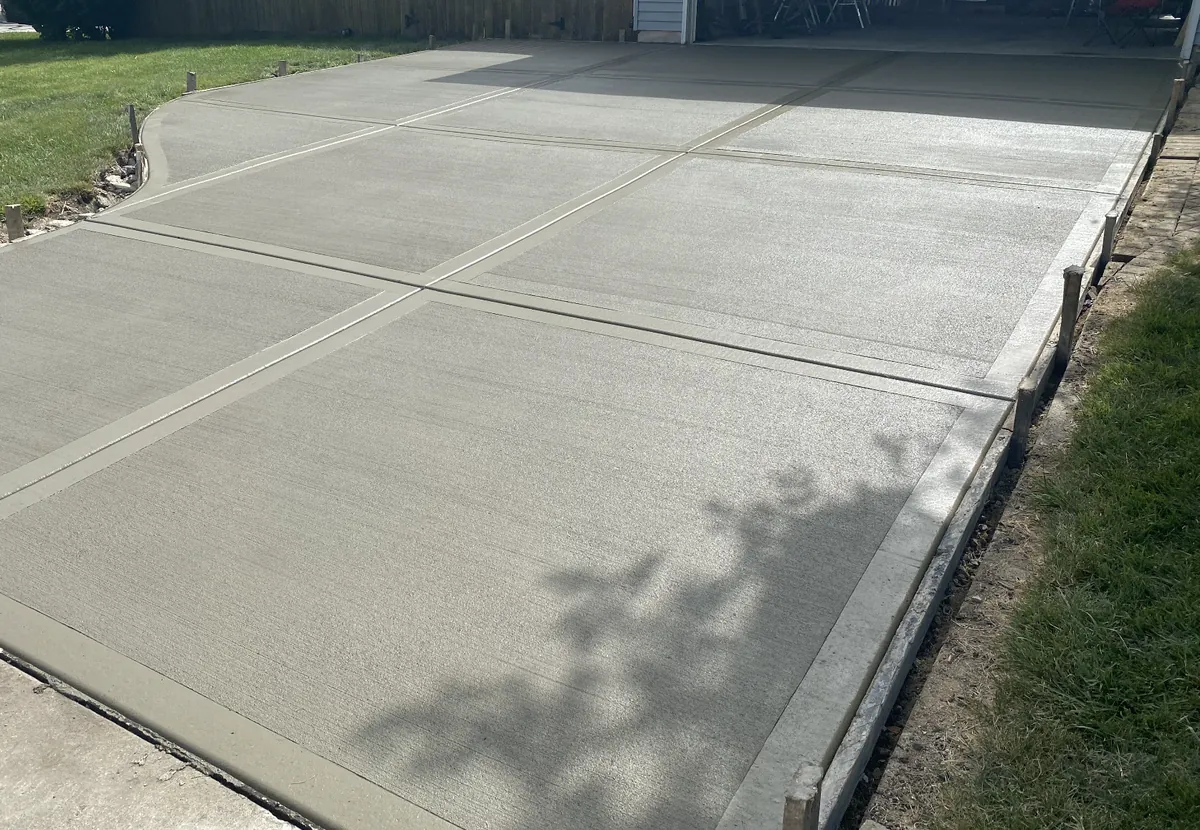
Here is the part that costs us work: for a lot of driveways, broom is the right answer. A well-finished broom driveway grips fine, shovels easily, is the cheapest to pour, and is the easiest to patch if a section ever has to be replaced. If the main reason you want exposed aggregate is traction, a crisp broom finish gets you most of the way for less money.
Exposed aggregate earns its cost where looks and grip both matter: a front walk and driveway that set the tone for the house, a sloped drive, a patio that has to hide dirt and grill drips, or the slab around a pool. Stamped is the pick when you want a specific pattern, and it is a different job entirely; see our stamped concrete page for that.
An Exposed Aggregate Driveway in a Schaumburg Winter
The Village of Schaumburg's climate table puts the frost line at 42 inches and rates weathering as "Severe." That is the code's way of saying exterior concrete here gets frozen, thawed, wetted, and salted every winter, and an exposed aggregate driveway takes that on a surface that is mostly stone tops and thin paste between them.
- Air-entrained mix, every time. Tiny entrained air bubbles give freezing water somewhere to go. The paste between exposed stones is thin, so a mix without enough air scales out from between the stones and leaves them standing on nothing.
- A base that drains. Most lots around here sit on clay-loam that holds water and heaves when it freezes. A compacted crushed stone base under the slab keeps the subgrade from moving the driveway around, and it matters more on an exposed aggregate slab because cracks and patches show more on it.
- No deicers the first winter. Young concrete is the most vulnerable to salt. Through the first winter, use sand for traction and shovel early. After that, go easy on salt, and never use ammonium nitrate or ammonium sulfate products, which attack the concrete itself.
- Gentler snow removal. A steel shovel edge or a plow blade set too low rides on the stone tops and can chip them. Ask your plow service to lift the blade a touch, and use a plastic shovel at the house.
Many owners also put a penetrating sealer on an exposed aggregate driveway every few years as routine maintenance to slow salt and water from soaking in. It helps. It is not a substitute for a good mix and a good base.
The strip at the street is the village's call
The part of the driveway between the sidewalk and the street sits in the village right-of-way, and work there needs a Village of Schaumburg permit. Before you plan a stone finish all the way to the curb, we check what the village allows in its right-of-way and pull the permit. Inside your lot line, the finish is your choice.
Where Exposed Aggregate Goes Wrong
Exposed aggregate fails in a handful of predictable ways. Most of them are decided on pour day. Open each one to see what it looks like and what causes it.
Popouts: small cone-shaped pits with a broken stone at the bottom
A popout happens when a porous stone near the surface soaks up water, the water freezes, and the stone bursts, taking a little cone of concrete with it. Chert and some shales are the usual culprits. They usually show up within the first year and are mostly cosmetic, but on an exposed aggregate surface every stone is at the top, so a mix with porous particles in it shows them more. The prevention is stone choice: ask what the aggregate is before it is seeded or batched.
Stones loosening and kicking out
This is almost always over-exposure. The wash took off more than about a third of the stone, or it started before the paste could hold, and now the stones are sitting in a shallow cup. They loosen under tires and shovels and leave empty sockets behind. A seeded stone that was not pressed in well fails the same way. Once it starts, it keeps going.
Patchy or uneven exposure
Some areas show bright stone, others look muddy or barely etched. The cause is uneven retarder coverage, part of the slab drying faster in sun or wind, or a timed wash that reached one end of the slab too late. It is permanent, so it has to be prevented: even retarder coverage, the slab covered after spraying, and a crew big enough to wash the whole pour inside its window.
Scaling between the stones
The thin paste between exposed stones flakes away, leaving the stones standing proud and then loosening. The usual causes are a mix without enough entrained air, deicers on young concrete, or both. It is the same scaling that hits broom slabs in the NW suburbs, it just shows up between the stones.
A replaced section that does not match
Not a failure of the original pour, but plan for it. If a section is cut out later for a utility line, a sunken panel, or a widening, the new concrete will not match perfectly. The stone may come from a different batch, the exposure depth will differ a little, and the old surface has weathered. Using the same plant and the same retarder strength gets it close. Close is the honest promise.
We pour new exposed aggregate. We do not take on re-exposing, restoring, or re-washing an old aggregate surface as a separate job, because the paste is already hard and the original look cannot be brought back with the methods used on fresh concrete. When an old aggregate slab has failed, the fix we can offer is a new pour.
Exposed Aggregate Patios, Front Walks, and Pool Surrounds
Driveways get the most attention, but the finish works just as well behind and beside the house.
Back patios
Exposed aggregate is one of the finishes on our concrete patios, and it suits a patio that sees grill grease, muddy shoes, and leaves, since the stone texture hides all three. If you set a dining table or lounge chairs on it, a smaller rounded stone and a lighter exposure keep chair legs steadier.
Front walks and side paths
A front walk is where people slip, so it is a natural place for the extra grip, and a walk that matches the driveway ties the front of the house together. In Schaumburg, keep the front yard math in mind: the village caps total coverage at 40% of the front yard, so a wider walk or a bigger landing pad adds to that total no matter how it is finished.
Pool surrounds
Around a pool, slip resistance comes first. We lean toward exposed aggregate or a heavy broom finish there. Choose a small rounded stone, keep the exposure shallow so it is not hard on bare feet, and pitch the slab away from the pool coping and the house.
What Exposed Aggregate Costs Over Broom
By the numbers in our 2026 driveway cost guide, exposed aggregate adds roughly $2 to $3 per square foot over a broom finish. For context, a straightforward broom finish driveway replacement in Schaumburg and the nearby suburbs runs about $9 to $15 per square foot in 2026, and a stamped finish adds roughly $4 to $8 over broom.
Where your job lands inside that range for the finish:
- Mix stone or seeded stone. Exposing the stone already in the mix costs less than buying decorative stone and seeding it.
- The stone itself. Some decorative stones cost more to buy and haul than others.
- Size of the pour. The retarder, the wash, and the extra crew time on wash day cost more per foot on a small walk than on a big driveway.
- Borders and bands. A smooth troweled or broom border around exposed aggregate means more forming and finishing.
- Weather. Hot, windy days shorten every window. Sometimes the right call is to move the pour, and we would rather do that than wash a slab unevenly.
Everything else that moves the price is the same as any slab: tear-out, base work, access, and any village permit. We measure, look at the site, and put the scope and the price in writing.
What to Ask Before You Sign for Exposed Aggregate
- Retarder or timed wash? Either can work. Ask how they will make sure the whole slab gets washed inside its window.
- Which stone, exactly? Ask to see a sample of the actual stone, and ask whether it is the plant's mix stone or seeded.
- How deep is the exposure? Light, medium, or deep, and how they keep it at no more than about a third of the stone.
- Is the mix air-entrained? It should say so in writing. Ask what the bid lists for air.
- What is under it? Compacted crushed stone base, and how thick. Not pea gravel.
- Where do the joints go? Control joint layout is part of how the finished slab looks, and saw cuts on exposed aggregate should be clean, not ragged.
- Who pulls the permit for the street end? If the job touches the right-of-way, the answer should be the contractor.
- What happens if it washes unevenly? A good contractor has an answer before pour day, not after.
Exposed Aggregate FAQ
Less than most finishes. The tops of the stones stay rough for the life of the slab, so it grips better than a troweled or stamped surface when it is wet, and better than an older broom finish whose ridges have worn down. No concrete grips on glare ice, though. Shovel early and use sand the first winter, and go easy on salt after that.
Close, not perfect. A new section will use stone from a different batch, the exposure depth will differ a little, and the old surface has weathered. Using the same plant and the same retarder strength gets it as close as it can get. If a future cut is likely, such as a planned widening, a smooth or broom border between sections makes the seam look intentional.
It can be. Crushed stone with a deep exposure is rough on bare feet and knees. For a pool surround or a patio where kids play barefoot, choose a small rounded stone such as pea gravel and keep the exposure shallow. It still grips well and is much easier underfoot.
Not in any way we would recommend. The stone gets exposed while the concrete is fresh, by holding back or washing off the top paste before it hardens. On an old slab that paste is already hard, and grinding or blasting it off chips and dulls the stone. If you want exposed aggregate, it comes with a new pour.
Foot traffic after 24 hours. On a driveway, passenger cars after 7 days, and heavier vehicles after 28. The wash itself happens the day after the pour when a retarder is used, so expect the crew back that day. Keep deicers off it for the entire first winter and use sand for traction.
Related Finishes, Services, and Nearby Towns
Other concrete work we do
- Concrete Patios: backyard slabs, pool decks, and outdoor kitchen pads in broom, exposed aggregate, or stamped.
- Concrete Driveways: new pours and full tear-out replacements, with broom as the standard finish.
- Stamped Concrete: flagstone, slate, cobblestone, and wood plank patterns.
- Sidewalks & Walkways: front walks and garden paths built to village spec.
- Driveway cost guide: what goes into a 2026 price in Schaumburg, line by line.
Exposed aggregate in nearby suburbs
- Palatine: the north side toward Deer Grove Forest Preserve, where bigger lots and longer driveways draw stamped or exposed-aggregate finishes.
- Carol Stream: broom, exposed aggregate, and integrally colored patios sized to typical rear yards.
- Wood Dale: smaller patios sized to the typical Wood Dale rear yard, in broom, exposed aggregate, and integrally colored finishes.
Thinking About Stone in Your Next Pour?
Free on-site estimate within 48 hours. We will talk through stone choices, tell you plainly whether exposed aggregate or broom is the better fit for that spot, and leave you with a written quote.
847-610-6459