
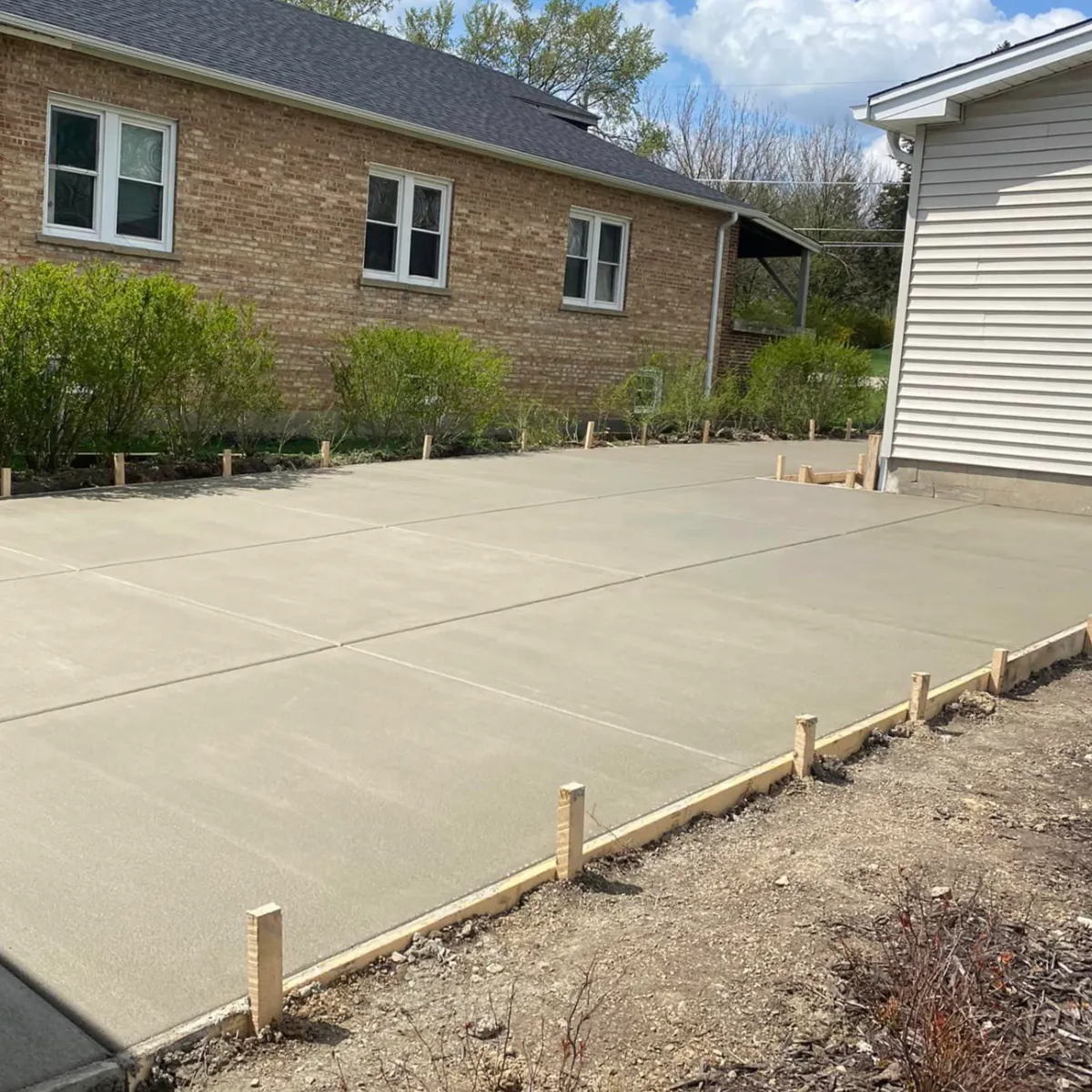
Concrete Patios in Schaumburg, IL
Entertaining slabs, pool decks, and outdoor kitchens, poured so water drains away from your house, not toward it.
Free Concrete Patio Estimates in Schaumburg
Tell us where the patio is going and how you want to use it. We will walk the yard with you, talk through size, drainage, and finish, and put the estimate in writing.
Prefer to talk it through? Call 847-610-6459, Monday to Saturday, 7am to 6pm.
Get a Free Estimate
Tell us about the project and we will get back to you within one business day. Prefer to talk? Call 847-610-6459.
This is a great company that truly cares about their customers. We have collaborated on a few projects and everytime we have been impressed by the attention to detail and worksmanship. This company is a great resource for Schaumburg homeowners to consider when they are in the market for new concrete.
Concrete Patios That Work for the Life You Actually Live
A good backyard patio is one you use four seasons out of four: cookouts in July, fire pit in October, hot tub in February. For a concrete patio in Schaumburg, IL to earn that, the slab has to be big enough for what you really do out there, tied into the house at the right elevation, and pitched correctly so you're not chasing puddles off the surface every time it rains.
As a concrete patio contractor, we've built patios for homes all over Schaumburg and the surrounding suburbs. The calls we get most often: tired 15x15 slabs from the 1980s that are too small for a modern grill setup, cracked aggregate patios that have gone beyond repair, or brand-new builds where the homeowner wants a clean slate before the landscaper starts. Every one of those jobs gets walked on-site before we quote a dollar figure.
A patio isn't a driveway. It doesn't need to handle vehicle loads, so we can get more creative with finishes and shapes. But it has to drain, it has to tie into the house cleanly, and it has to survive the same Illinois winters. Our process is built around all three.
Concrete Patio Finish Options
You don't have to pick between "plain gray" and "paver look." There's a range of finishes for a poured slab, and each one has different cost, maintenance, and aesthetic tradeoffs. Here's what we actually build, not just what's in a brochure:
Broom Finish
The classic. A stiff brush drawn across the surface after the bull float gives you a consistent ridged texture with the best slip resistance of any finish. Lowest cost, highest durability, and easy to keep clean.
Exposed Aggregate
A surface retarder holds back the top paste while the slab below sets. Rinsed off the next morning, it reveals the decorative stone mixed into the top layer. Beautiful, grippy even when wet, and hides stains better than a broom finish.
Integral Color
Pigment added to the concrete at the plant so the color runs all the way through the slab, not just on the surface. Scratches don't reveal a different color underneath. Common choices: sand, buff, charcoal, terra cotta.
Color Hardener + Release
A dry-shake color hardener broadcast onto the fresh pour, worked in with the float, then a contrasting release agent before stamping. Gives you richer, more dimensional color than integral alone, and it's the basis for most stamped finishes.
Stamped Patterns
Flagstone, ashlar slate, European fan, wood plank, cobblestone. Tooled into the slab while the concrete is still at the right plasticity. See our stamped concrete page for patterns and details.
Saw-Cut Patterns
Diamond-blade cuts in a grid, circle, or custom layout after the slab has set. Creates the look of large tiles without the stamping cost. Often combined with integral color for a clean, modern look.
How We Spec a Concrete Patio
Patios fail differently than driveways, usually from bad drainage or bad expansion joints at the house tie-in, not from the slab itself. Here's what matters in a patio built for this climate:
- Thickness matched to the load. A loaded hot tub can push 500 lbs per square foot when it's full. A 4" slab will crack under that. We ask up front what's going on the patio so the thickness matches the load.
- Air-entrained mix. Same approach we use on driveways. Freeze-thaw doesn't care whether the slab sees tires or lawn chairs.
- Welded wire mesh or fiber reinforcement. Wire mesh is our default for most residential patios. Synthetic fibers are an alternative for smaller slabs where chair height isn't an issue.
- Pitched away from the house. Steeper than a driveway. Water has to move fast enough that it doesn't sit on the slab and work its way into hairline cracks or the house foundation.
- Expansion joint at the house. Closed-cell foam joint material against the foundation so the slab can flex without transferring force into the house wall. This is the #1 detail we see missed on older patios.
- Control joints laid out and cut on time. Saw cuts give the slab a planned place to crack as it shrinks during the first month.
- A compacted stone base. Less depth than a driveway since there's no vehicle load, but still fully compacted.
Patio Installation and Replacement Projects We See Most
Backyard entertaining slabs
The most common call. Homeowners want to upgrade from a small deck or undersized old patio to something that actually fits a dining table, a grill island, and a seating area. Usually 300 to 600 square feet with a broom or exposed aggregate finish.
Pool decks
Around an in-ground or above-ground pool. Slip resistance is critical, so we lean toward exposed aggregate or a heavy broom finish. Pitch drains away from the pool coping and from the house.
Outdoor kitchen pads
Thicker slab to support built-in grill islands and stone veneer. We coordinate with the mason and the gas line installer to leave clean sleeves in the pour.
Multi-level patios with stepdowns
For yards that slope. We pour each level as its own slab with an expansion joint between them and a poured concrete stepdown. Looks intentional, drains correctly, and doesn't crack at the transition.
What a Concrete Patio Costs in Schaumburg
Patio pricing swings more than driveway pricing, because the finish does most of the talking. A broom finished patio is the least expensive slab we pour. Going by the numbers in our 2026 cost guide, exposed aggregate adds roughly $2 to $3 per square foot over broom, and a stamped finish adds roughly $4 to $8.
Size is the next piece, then what has to happen before the pour. Tearing out an old patio, fixing a yard that drains toward the house, or pumping concrete to a backyard the truck can't reach all add to the job. A simple square slab on an open lot sits at the low end. A multi-level patio with stepdowns and a stamped border sits at the high end.
We don't price a patio off a photo. We walk the yard, measure, talk through how you plan to use the space, and put the estimate in writing.
Concrete Patio FAQ
A poured slab is monolithic, so there's nothing to heave or settle independently. Pavers look great when they're brand new, but Illinois clay soils shift with freeze-thaw and pavers need re-leveling every few years unless the base was built perfectly from the start. Concrete is a one-time install. If it's spec'd right, you're done for 25+ years. Pavers you're fussing with for the life of the patio.
Light foot traffic after 24 hours, so you can walk on it to bring the grill back out. Patio furniture and normal cookout use after 3 days. Hot tub, heavy planters, or anything that puts concentrated load on the slab should wait a full 28 days so the concrete is at its design strength. We'll tell you on-site exactly when each piece of outdoor gear can go back.
Yes, and it's worth doing. A penetrating silane/siloxane sealer every 3 to 4 years keeps deicing salt, grease from the grill, and ground moisture from soaking into the slab. Stamped or integrally colored patios need a more frequent film-forming sealer, usually every 2 years, to keep the color looking sharp and protect the stamped texture.
Yes, and how it's tied in matters a lot. We install a closed-cell foam expansion joint between the new slab and the foundation so the patio can flex independently without cracking the siding, stucco, or brick veneer. We also make sure the final elevation slopes away from the foundation. Water running toward the basement wall is how small problems become big ones.
Broom (the standard, best slip resistance, lowest cost), exposed aggregate (decorative and grippy), integral color (pigment runs all the way through), color hardener with release (richer, more dimensional color), stamped patterns (flagstone, slate, cobblestone, wood plank), and saw-cut patterns (large tile look). We bring samples to the estimate so you can see what each one actually looks like in daylight, not just a brochure photo.
It depends on the village and on what you are building. Rules for patios vary across the NW suburbs, and a patio tied to a new addition, a pool, or a change in grade is more likely to need one. We check with the village before we schedule and pull whatever permits the job needs.
Related Services & Service Areas
Other concrete work we do
- Stamped Concrete: stamped patterns for patios, pool decks, and walkways.
- Sidewalks & Walkways: paths from the patio back to the driveway or side yard.
- Concrete Driveways: rip-and-replace and new construction driveways.
- Foundations & Slabs: for shed pads, outdoor kitchen platforms, and additions.
Patio work in nearby suburbs
- Arlington Heights: entertaining patios and pool decks.
- Elk Grove Village: backyard slabs on older mid-century lots.
- Hoffman Estates: stamped and exposed aggregate patios.
Ready to Build the Patio You Actually Want?
Free on-site estimate within 48 hours. We'll walk the yard with you, check drainage, measure for furniture layout, and leave you with a written quote and finish samples.
847-610-6459