
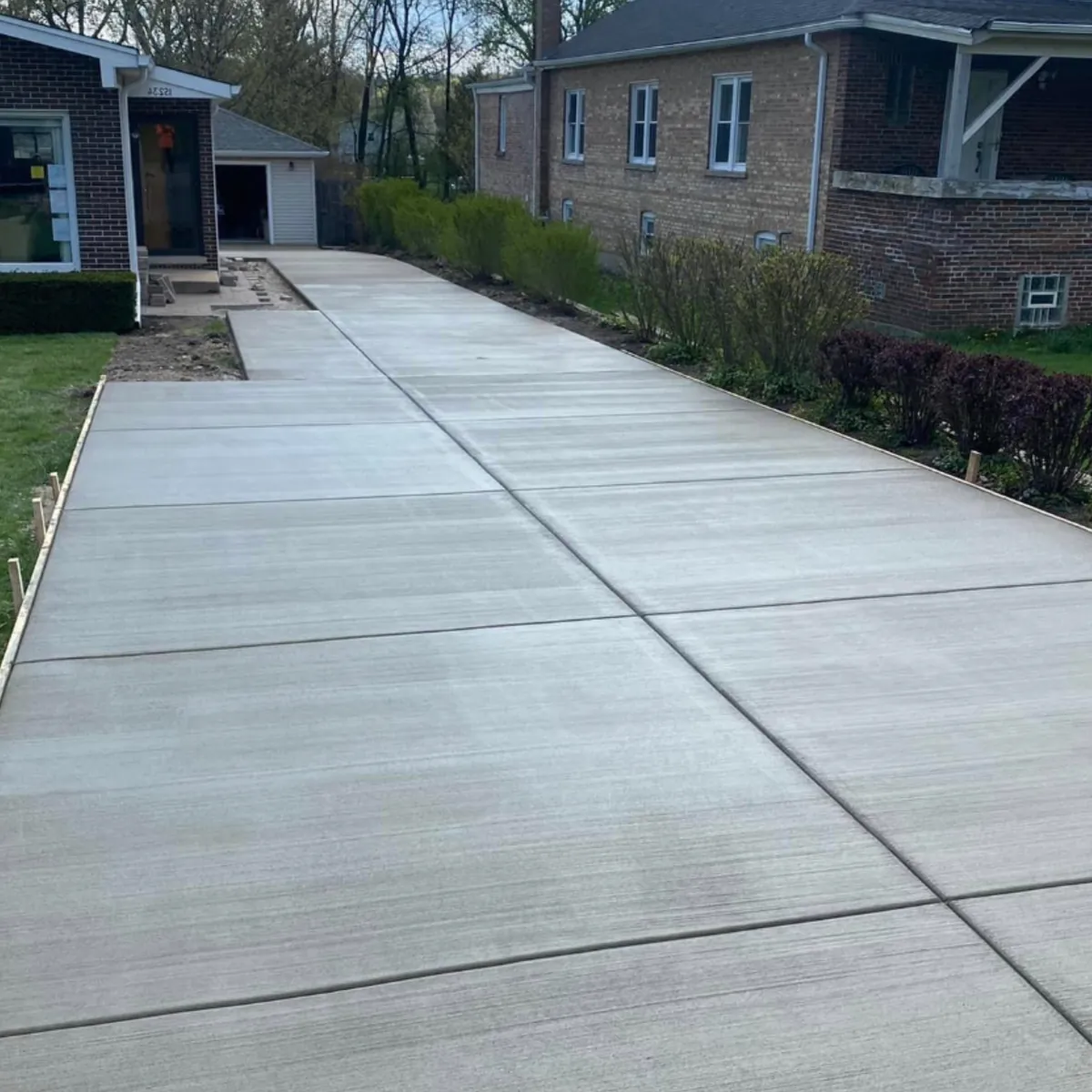
Concrete Driveways in Schaumburg, IL
New pours, tear-outs, and aprons, built to hold the line for 25+ Illinois winters.
Free Concrete Driveway Estimates in Schaumburg
New driveway, full tear out and replacement, a wider pad, or an apron that has seen better days. Send a few details or call, and we will come out, measure, and put the estimate in writing.
Prefer to talk it through? Call 847-610-6459, Monday to Saturday, 7am to 6pm.
Get a Free Estimate
Tell us about the project and we will get back to you within one business day. Prefer to talk? Call 847-610-6459.
We had an incredible experience getting my mother's driveway replacement done with this company. The finish is pristine! My father laid cement for 10 years and he said the work was exceptional as well. They made the process easy for my parents who are getting very old.
Concrete Driveways Built for Illinois Weather, Not a Brochure
Your driveway takes more punishment than any other concrete on your property, and a concrete driveway in Schaumburg, IL takes more than most. Two-car loads twice a day. Deicing salt from November through March. Freeze-thaw cycles that expand every hairline crack. A driveway is either spec'd to survive that, or it isn't.
As a concrete driveway contractor in Schaumburg, we handle new driveway installation, full driveway replacement on tired 1980s slabs, apron extensions for new garages, and ribbon strips, here and across the surrounding NW Chicago suburbs. We do the whole job in-house. No sub-ing out the finish work to someone we've never met. No showing up Monday, leaving Tuesday, and coming back three weeks later. When we start a driveway, we're on-site every day until the curing compound is down.
If you've seen a Schaumburg driveway scale, pop, or crack across the middle by year five or six, that's almost always a spec problem, not a concrete problem. Thin slab on poor subgrade, low air entrainment, no control joints in the right places, or curing cut short because the crew was already onto the next job. We don't work that way.
Driveway Installation, Replacement, and Repair
New Construction Pours
Full driveways on new builds, garage additions, or vacant lots. Subgrade prep, forms, rebar, pour, and finish. We coordinate with builders and homeowners on timing around landscaping and utilities.
Tear-Out & Replace
Demo the failed slab, correct the subgrade, and pour a new driveway the right way. This is the most common call we get: people whose original driveway hit its limit after 20 to 30 years.
Aprons & Approaches
The strip between your driveway and the street. Usually governed by village standards in Schaumburg, Hoffman Estates, and surrounding municipalities. We handle permits and coordinate inspection.
Extensions & Widening
Added a third bay? Need parking for an RV or trailer? We widen existing driveways with a tied-in expansion joint so the old slab and the new pour flex independently.
Ribbon & Decorative Strips
Concrete ribbons with a stone or paver infill. Gives you the durability of a poured surface where the tires actually run, with an accent finish through the middle.
Saw-Cut Joint Repair
If your driveway is mostly sound but the control joints have opened up or chipped, we can saw-cut and re-seal the joints to stop water infiltration before it turns into bigger damage.
How We Spec a Concrete Driveway
No shortcuts on the parts you can't see after the pour. Here's what matters in a driveway built for this climate:
- Air-entrained mix. The air bubbles are what let concrete survive freeze-thaw without scaling. Below 5% and you're gambling.
- Thickness matched to the load. Heavier vehicles like RVs and trucks need a thicker slab, and thickened edges at the perimeter keep the slab edges from cracking where the load is highest.
- Rebar or wire mesh, sized to the load. Reinforcement doesn't prevent cracks. It holds the slab together when they happen, which they will.
- A compacted stone base. Subgrade is where most failed driveways actually fail. We compact in lifts, not one big dump.
- Control joints laid out and cut on time. Joints give the slab a planned place to crack as it shrinks, so the layout and the timing of the saw cut both matter.
- Pitched to drain. Drainage away from the garage and house. Standing water at the slab edge is how spalling starts.
- Proper curing. Curing compound over the entire surface slows moisture loss during the critical first 7 days.
The Best Time to Pour a Driveway in Illinois
We pour driveways from mid-April through late October most years. That's the window where daytime temperatures hold above 50°F and nighttime lows stay above 40°F for the first week of cure. Outside that window we can still pour with insulated blankets and heated enclosures if a project is urgent, but we're upfront about the added cost.
Spring pours are the most common. Homeowners want the driveway done before summer entertaining. Fall pours are actually our favorite technically: cooler temperatures slow the initial set and give us a longer finishing window, and the slab has time to gain strength before the first freeze. Mid-summer pours require careful timing around afternoon thunderstorms and we often schedule early morning starts.
What a Concrete Driveway Costs in Schaumburg
Most calls start with the same question, so here is the plain answer. A straightforward concrete driveway replacement in Schaumburg and the nearby NW suburbs runs about $9 to $15 per square foot in 2026. On a typical two-car driveway of around 600 square feet, that works out to roughly $5,500 to $9,000.
Where your driveway lands in that range comes down to a handful of things: how much old concrete has to come out, what the base looks like once it does, how easy it is to get a truck to the pour, whether the apron needs a village permit, and the finish you pick. Broom finish is the standard. Exposed aggregate and stamped borders cost more.
Our Schaumburg concrete driveway cost guide walks through each part of the price and shows what a low bid usually leaves out. For a real number on your own driveway, we come out, measure, and put the estimate in writing.
Concrete Driveway FAQ
25 to 30 years when it's spec'd right. The levers are an air-entrained mix, proper subgrade prep, rebar or wire mesh reinforcement, and sealing every 3 to 4 years to keep deicing salt from soaking in. We've pulled out 1970s driveways that were still structurally fine but just looked old, and we've pulled out 10-year-old pours that failed because they were 3" thick on uncompacted dirt.
Concrete costs more up front but lasts about three times as long. Asphalt wants resealing every 2 to 3 years and full replacement in 12 to 15 years. Concrete handles the freeze-thaw cycle better when it's air-entrained correctly, doesn't soften in July heat, and stays looking sharp instead of fading and alligator-cracking. If you're in your forever home, concrete is the math. If you're planning to move in 5 years, asphalt is cheaper to get out the door.
We don't recommend it. Whatever's failing underneath (heaved subgrade, alligator cracking, sunken sections, or tree roots) telegraphs through the new slab within a season or two. A bonded overlay is a short-term band-aid. Proper tear-out, subgrade correction, and a fresh pour is what we do, and it's the only way to get the full service life out of new concrete.
Foot traffic after 24 hours. Passenger cars after 7 days. Delivery trucks, RVs, or anything with tandem axles after 28 days. Concrete keeps gaining strength for months (90% of its design strength comes in around day 28), so the 7-day number is when it's safe for daily use, not when it's done curing.
Square footage first. Then tear-out of existing concrete, subgrade condition (is there good compacted base under the old slab, or clay soup?), reinforcement spec, finish type, whether the apron needs a village permit, and access to the pour area. You get a written estimate that spells out the scope, so you see exactly what you're paying for. No lump-sum mystery numbers.
It depends on where the work is. The apron, the strip between your driveway and the street, sits in the village right-of-way, so work there goes through the village. Rules for the rest of the driveway vary from town to town across the NW suburbs. We check with the village before we schedule and pull whatever permits the job needs, so you are not left sorting out the paperwork.
Related Services & Service Areas
Other concrete work we do
- Concrete Patios: broom, exposed aggregate, and stamped patios with proper drainage.
- Stamped Concrete: the look of pavers with the durability of a monolithic slab.
- Foundations & Slabs: garage floors, addition footings, shed pads.
- Sidewalks & Walkways: front walks, ADA ramps, and step repairs.
- Garage Floor Repair: cracked, pitted, or sunken garage floors, repaired or replaced.
Driveway work in nearby suburbs
- Hoffman Estates: driveway replacements in older Parkwood and Hilldale neighborhoods.
- Palatine: new pours and aprons north of Schaumburg.
- Elk Grove Village: residential and light commercial driveway work.
Ready to Replace That Driveway?
Free on-site estimate within 48 hours. We'll walk the driveway with you, measure, check subgrade access, and leave you with a written quote, not a lump-sum number.
847-610-6459